Showing posts with label Transmedia. Show all posts
Showing posts with label Transmedia. Show all posts
Sexy Chinese Content: Slipping One Past the Censors 苹果陈 @loora8888
I have been spending a lot of time in Asia. To support myself? I do several things - a number of them under the banner of “teaching”. One organizing principle of my “teaching”? Trying to figure out how stories are being told and shared using new motion picture tech. How does that manifest in my life? I try to find (paying?) opportunities to share what I’ve learned in Asia watching things online - like the Hong Kong protests or web content in China.
So?
I saw loora8888.
I’ll admit, the apparent street photography coupled with fearless beauty and a sexual connection to the camera is where my fascination started. But from that first connection flowed other questions.
Who are they? What’s with their physical intimacy? Are they gay?
Not likely.
In China right now gay stories are banned - and an author of gay-erotica was recently sentenced to 10 years in jail.
So?
It seems they are sisters.
Ok. That part makes sense. Even though, in my life, I’ve only known a few sisters whose connection was truly that exhilarating. I get who they are. And it gets them past the Chinese censors. In other words? Their intense connection, coupled with their intoxicating playful sexual confidence on camera, now made sense to me as a China-watcher and supporter of civil rights for gay people.
But then my producer-self asked - who or what is paying for all this?
The answer?
They are marketing the clothes they design.
Truly? Next level stuff. And? For me? This is yet another example of how some major obstacles (Chinese censorship) and the new tools are inspiring amazing work that contributes to the ongoing democratization of motion picture production.


Is Chinese E-Commerce Giant Alibaba Investing in Magic Leap, a South Florida Augmented Reality Technology Firm?
The video above was reportedly shot using Magic Leap technology on October 14th, 2105, without the use of special effects or compositing.
Following reports in early October 2015 that Magic Leap was seeking yet more funding ($US 1 billion - which would value the company at US $4.5 billion) for their still secret (but rumored to be ground-breaking) augmented reality (AR) technology, an October 25th, 2015 report in recode suggests that "Chinese e-commerce giant Alibaba [has been identified as] the lead investor in a new round. Sources say Alibaba is likely to put around $200 million into the Florida based-company."
It was exactly one year ago that Magic Leap was said to have raised close to US $500 million in an earlier round from heavy-hitters like Google, chipmaker Qualcomm; Legendary Entertainment (producers of movies like “Godzilla” and “Interstellar”), Obvious Ventures (an investment fund co-founded by Twitter co-founder Ev Williams along with entrepreneur and investor James Joaquin) and Silicon Valley venture capitalists Andreessen Horowitz.
Immersion Gets Physical: VR and CableBOT
As VR headsets like the Oculus Rift are expected to roll-out for sale to the general public in early 2016, the ways in which headset users can immerse themselves into new VR experiences are still expanding.
Meet CableBOT.
As the video shows, a (lucky?) VR user is strapped into a seat atop a platform that is suspended in a large room - that is in turn attached to a series of motorized pulleys.
The the computers and pulleys take over.
Apparently convincing your body that you are swooping through space is a lot easier if you're actually swooping through space.
Based on robotic platforms for performing maintenance on large sale projects - like huge airplanes, the device in the video above was built by Professor Heinrich Bülthoff and colleagues at the Max Planck Institute for Biological Cybernetics.

According to a September 28th, 2015 post to radiotovr.com Dr. Bülthoff's "CableBOT is comprised of a central ‘cockpit’ frame, complete with chair, harness, modified Oculus Rift DK2 and computer to power it. The central cockpit is attached to a series of motorised winches which are coordinated to apply or release tension to and from the cockpit in such a way as to allow elevation, descent and rotation of the platform – giving a full six degrees of freedom for movement (6DoF)."
Thanks to transmedia author and consultant Michel Reilhac for the link to CableBOT article in radiotovr.com.
How Long Before We Get Star Wars and Marvel VR Experiences?
Arthur Van Hoff is the (sorry to say, uncharismatic) CTO of Jaunt VR.
In the video above (recorded at the VRLA Spring Expo, where approximately 50 vendors gathered at the Los Angeles JW Marriott LA on March 22, 2015 to show off their soon-to-be-on-the-market VR wares) Mr. Van Hoff talked about Jaunt's progress toward enabling what they were calling "cinematic VR."
But his demos and personality don't convey why people should care.
What does "cinematic VR" mean anyway?
And why does it matter?
Without a proven market for the bulky wearable VR devices - why are people writing about it in 2015?
After all, Jaron Lanier's pioneering VR company went bankrupt back in 1990.
Who really thinks this year's VR hype will come to anything. Remember Google Glass?
Well... VR may land with a thud when Oculus finally ships to consumers (first quarter of 2016?). And the talk of "cinematic VR" may once again prove to be just talk.
We'll know soon enough...
But don't bet against VR just yet...
The last week has seen some quietly reported milestones that could expand into big news
For example?
When VR developers start attracting backing from one of China's biggest investors in Hollywood (i.e., China Media Capital - which has recently announced a major deal with Warner Brothers for Chinese language films) AND a legacy movie studio - one with the hottest motion picture franchises (i.e., Disney, with properties that could spin-off amazing VR experiences, like Star Wars and Marvel) BOTH signing on to work with a fledgling VR company - it may be time to pay attention.
And perhaps to get a bit excited about the cinematic possibilities.
And that's exactly what happened just this week, as the signs of something major happening in VR started to come together.
First there was the announcement on Sept. 16th, 2015 that Disney-owned ABC News would be offering a VR storytelling "experience," produced in conjunction with Jaunt, to take the viewer "Inside Syria to explore Damascus and see how archaeologists are racing against time to protect historical antiquities menaced by war."
Then just five days later Daniel Terdiman in Fast Company wrote (on Sept. 21st, 2015) that the "Walt Disney Company is among the lead investors in virtual-reality startup Jaunt VR’s $66 million Series C round of funding... and China Media Capital joined Disney as lead investors in the round, which brings Jaunt’s total funding to more than $100 million."
Think about it.
In one week, Disney made two bold moves - with Jaunt - into VR.
With Disney onboard, we are no longer simply talking about building a 360 degree camera and tools for editing and creating VR experiences.
The Story Studio announced earlier this year by Jaunt's competitor Facebook-owned Oculus was one thing. But Jaunt's new relationship with Disney (with money from China Media Capital) could be huge.
Yes. There's still a long way to go - but if the birth of a major new studio-of-the-future was to happen - wouldn't it look a lot like Jaunt and Disney teaming up?
Let's be clear. This is all very speculative. But the news that Disney and China Media Capital are building an experience production facility - with a sound stage and the kinds of tools that Hollywood motion picture storytellers might want to craft entertainment experiences for VR headsets - in Hollywood - should be very big news.
Yes. It's probably too early to announce a trend. But both Oculus and Jaunt seem to be expanding their vision from building a workable technology suitable for gaming into something much bigger. Their growing confidence in movie-like storytelling (for the home and a new kind of theater or theme-parks?) may simply be an effort by these early-stage businesses to cover all the possible bets - but this kind of move - toward a new paradigm for film storytelling with Disney and big Chinese money attached - seems noteworthy.
Let's see if the mainstream media picks up on the news that a stable of properties that include Star Wars and Marvel are now deeply embedded into a company that is promising "cinematic VR."
UPDATE: May 31, 2016 The indispensable Patrick Frater is reporting in Variety that Jaunt is establishing a joint venture - to be known as Jaunt China - with Chinese media titans Shanghai Media Group and Whaley (the technology arm of China Media Capital, a prior investor in Jaunt, see above) with the goal of bringing cinematic VR experiences to the China market. What Patrick Frater doesn't mention is that, at the same time in the US, Jaunt's CEO has "stepped down."
Star Wars Secret Cinema Event: Monetizing a Phenonmenal Experience
A long time ago in a galaxy far, far away.... (OK... East London... in the summer of 2015), fans could experience Star Wars in a phenomenal way.
As described in a June 12th, 2015 piece in The Telegraph: "Secret Cinema’s The Empire Strikes Back event, the latest offering from the immersive cinema company, isn’t exactly the same as actually being in a Star Wars film – but it’s probably still the closest you’re going to get whilst still actually in this galaxy. More importantly, it’s also ridiculously good fun."
When even the most epic of motion pictures can be watched on a mobile device... and almost every film ever made is available at the end of just a few keystrokes... the business of creating one-of-a-kind live film-themed events may seem a bit archaic. But, as Brian Clark predicted, creating phenomenal experiences - for example, an event where fans can step inside the world of the film and then see the film with other jacked-up fans - presents yet another monetizable model for connecting fans and filmmakers around the stories that we love.
I'm eager to see what Siobhan O'Flynn (my pal who, like me, teaches about this new world of movies, and who alerted me to the article in The Telegraph) writes about this...
Real Live Zombie Apocalypse Surprises Chatroulette Users
In the summer of 2015, some lucky users of anonymous chat sites (like Chatroulette) were conscripted into a surprisingly elaborate zombie apocalypse set in an interactive real world environment.
I was surprised how much fun I had watching the apparently unsuspecting participants as they adapted to a real-life first-person shooter game.
The whole experience was created and filmed by Realm Pictures (a UK based studio).
For a more complete explanation of how and why the video was made, here is the Realm Pictures "making-of" video:
Thanks to award-winning filmmaker Jeff Orlowski for bringing this one to my attention.
Evolution of Verse, VR and VRSE
The video at the top of this post is entitled Evolution of Verse.
At first glance - it's just another computer-generated landscape...
But hit play. If you're using a computer to read this, what's the little disc with arrows in the corner of the frame?
Maybe there is more to Chris Milk's video than meets the eye...
Give it a try... especially if you're unfamiliar with virtual reality ("VR").
People have been touting VR for years.
Jaron Lanier was manufacturing VR devices in the 1980s. And his company, VPL Research, was bankrupt by the 1990s.
Back then, the images lacked realism.
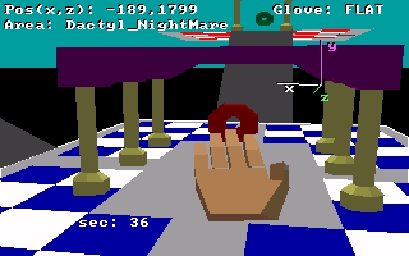
And even today, VR in practice is still a bit clunky - an apparently early-stage technology, that can turn off potential users who wouldn't be caught dead wearing geeky-looking isolating headsets.
And leaving aside the creepy headgear - why are the VR demonstration videos that are offered online so often so dull?
Do we really need another fan-boy recreation of Star Trek's holodeck or another vr-for-its-own-sake music video?
Nevertheless, recently several large corporations have gotten on the VR bandwagon.
For example, in 2014 Facebook acquired Oculus Rift (reportedly paying US$2 billion for that company's virtual reality technology).
Which brings us to 2015.
Working with visual effects leader Digital Domain and Annapurna Pictures, director Chris Milk created Evolution of Verse to demonstrate the potential of VR.
Like the earliest motion pictures back in the 19th century, Evolution of Verse is short - clocking in at under 4 minutes - and relatively crude.
Nevertheless, Evolution of Verse premiered at the Sundance Film Festival in January of 2015.
Part of the excitement about Evolution of Verse is that the creator, Chris Milk, has a history of innovation.
And, please know, watching any VR demonstration on a laptop doesn't give the experience its due.
If you have an iPhone, Android, Samsung Gear VR or Google Cardboard device, download the free app at http://www.vrse.com to get a better sense (still far from immersive - but at least a bit more naturally interactive) of what watching VR with a headset feels like.
And for filmmakers who are interested in exploring the creative possibilities, here is some interesting news:
A January 28th, 2015 post to AdAge announced that Chris Milk, Patrick Milling-Smith and Brian Carmody had teamed up to open VRSE works, "an independent production company dedicated to virtual reality-focused projects."
What are the aesthetic goals of VRSE?
According to Mr. Milling-Smith: "Up until this point, it's been all about the technologists. What we're trying to do is bring real artists and filmmakers and a sense of story and marry that with the technology."
What is the revenue model of VRSE?
"The company will work with agencies and direct-to-client on branded projects."
Will VR spin off commercially viable products?
No one can say with certainty.
But... Would you bet against it?
Mr. Robot: How the Internet (and Anxiety about Big Brother, Corporate Villainy, Cyber Security and Ultimately the Unknowability of Others) is Fueling a Cable TV Hit
Mr. Robot is, IMHO, one of the best new shows on TV.
Some of us first learned about the USA Network show - about a hacker - played by Rami Malek - who struggles with questions of morality and identity in the dark corners of 21st century NYC - through social media recommendations.
Some may have encountered the faux-subversive campaign (see the video above) that "gamified" the cyber crime elements of the plot.
Maybe this is the first you're hearing about it.
No matter.
For marketing the show - and for the unique approach to storytelling that series creator and executive producer Sam Esmail has taken with Mr. Robot - the internet itself seems to be the point.
Even though Mr. Robot is being presented as weekly appointment (Old World day part) viewing on USA, it's the binge-watching audience parting experience of the internet - and its aesthetic of jumpy impermanence - that seem to define the show and Elliot Anderson's fundamental dilemma.
In the era of the Arab Spring and #Ferguson, it can't be accidental that the storytelling of Mr. Robot - with its unreliable narrator and non-linear approach to revealing character (for example, watch the way that the end of episode 6 flows into episode 7) - mirrors the experience of following hyperlinks in a (futile?) effort to get to the truth.
Pay attention to the way shots are framed. Slightly off-kilter. Visions of subway cars, corporate suites and abandoned spaces. Notice how the characters are lurking in the shadows of a shuttered Coney Island arcade or stumbling into an outer-borough shooting gallery. When we see faces - they are often slotted into slightly uncomfortable spots at the edge of the frame. Images seem to have been filtered through cellphones.
This is a show where the aesthetics and the experience of the internet - from how shots are framed and lit to how soul-piercing news can arrive with the bouncy sonic alert of a new email - are converging with traditional episodic TV.
And it isn't just the look and sound of the show (the soundtrack features Mac Quayle's totally electronic take on score as well as deft ironic choices, like episode 6's use of the Tangerine Dream cut that was also featured in 1983's Risky Business), Mr. Robot also captures the murky morality of an untrustworthy now...
Hollywood is in transition.
I imagine the Hollywood casting notice for Mr. Robot described Elliot Anderson as "a hacker with a gift for exploiting the cyber weaknesses of others - but his own weaknesses keep him strung-out on opiates - and barely hanging onto his gig at a strait-laced cyber security firm - as after hours he joins with an Anonymous-like hacker collective and struggles to find and hold onto his own identity..."
But that's not really it.
It isn't Elliot's hacking. It's not his relationship to his work, his fragile mental health, or his run-ins with corporate crime and drug crime, or even his struggles to unravel the secrets of his own identity that make this show so special...
What makes Mr. Robot compulsively watchable is its jittery (only sometimes fully-successful) re-imagination of network TV storytelling. Like Tony Soprano on HBO - Elliot Anderson is pushing boundaries on weekly ad-supported TV. He isn't always trustworthy or likable. But, just as in the 19th century photography “freed Western painting, once and for all, from its obsession with realism”, the internet (as seen in Mr. Robot) seems to be pushing the TV series away from the safe moorings of linear story and trustworthy narrators into new uncharted places.
UPDATE: Aug. 27th, 2015 Thanks to South East Asia-based Nicarauguan theater artist (and former student) Jaime Zuniga, I've just read Todd VanDerWerff's Aug. 26th, 2105 post to Vox about the unique look of Mr. Robot. Mr. VanDerWerff's post includes numerous screen-grabbed examples of how the visual aesthetic of Mr. Robot "gives the show an overriding feeling of coherence and thematic unity that exists in few brand new shows." Like me, Todd VanDerWerff sees intention behind the visual style of the show: Specifically, the show's shot composition often pushes characters away from what we've come to expect from traditional TV and movies based on the "rule of thirds" (places in the frame with "significant amounts of power"). Both Mr. VanDerWerff and I noticed that many of Mr. Robot's shots feature characters at the edgier edges. In my post from last week (above), I suggested the distinctive framing of shots in Mr. Robot might be part of an aesthetic informed by the internet - an intentional breaking of old rules shaped and colored by casual online filmmaking, selfies and cellphones snaps. Mr. VanDerWerff offers another possible explanation: "The system is so overwhelming that it's all the characters can do to stay in the frame. It keeps trying to push them out of it."
Monkey King Uses Crowdfunding and Online Marketing to Set Records for Chinese Animation
Monkey King: Hero is Back (西游记之大圣归来) is a record-setting 3D animated film (loosely adapted from the Chinese epic, A Journey to the West).
After opening on July 10, 2015, Monkey King: Hero is Back has been killing at the Chinese box office - estimated US$95 million as of July 26th, 2015. Even with stiff competition for screens from Monster Hunt (the live action/CGI fantasy that opened on July 16th, 2015 and rapidly became the highest-grossing Chinese movie of all time), Monkey King is now the all-time animation box office champion in China - surpassing Kung Fu Panda 2.
Success has many authors. And an entertaining well-made film at the right time counts for a lot. But there are a few wrinkles to the success of the Monkey King that New World filmmakers - and any Western filmmaker interested in doing business in China - might want to review.
First, it should be noted that Monkey King's numbers (and Monster Hunt's record numbers) are being racked up during China's unofficial “protection month” - an almost two month summertime period (legal under the WTO's cultural exception?) when non-Chinese films are excluded from opening on domestic screens.
Then there is the maturing of the Chinese film production and distribution infrastructure. China's film business is growing in ways that the US entertainment media has so far proven mostly incapable of covering. For example, the producers of Monkey King: Hero is Back include Beijing Weiyingshidai, Hengdian Chinese Film, October Animation and the Shandong Film and Television Production Center. And Monster Hunt was produced by 安樂影片有限公司 (Edko Films). Recognize those names from Variety or the Hollywood Reporter? Could that be because much of the US attention on Chinese film production has been narrowly focussed on legacy Hollywood-types partnering with Chinese money and workers? For example, when Western outlets (like the NY Times) write about Chinese film business developments, they typically spotlight companies like Oriental DreamWorks - a firm with a Western pedigree, even if partly owned by a Chinese government investment fund and a Chinese private equity firm, China Media Capital. Yes, the Chinese wing of Dreamworks is readying Kung Fu Panda 3 for release in 2016. But, besides Rob Cain's insightful items that are now appearing in Forbes and the great work by Asia Bureau Chief Patrick Frater in Variety, where is the discerning English-language reporting on newly powerful Chinese film production companies like Beijing Enlight, which is readying a sequel to their blockbuster Lost in Thailand (will Chinese audiences throng to Lost in Hong Kong?) and Huayi Brothers currently posting Search Tactic of the Light, adapted from a popular Chinese online novel?
In analyzing the Monkey King and Monster Hunt's successes, there's also the growing importance of family-friendly films in China (this summer, no fewer than 18 animated Chinese films have been scheduled to hit theatrical screens). Is this shift in genre getting the attention it deserves from Western experts?
Yet another interesting (to me) aspect of the Monkey King's remarkable box office build is the role that crowdfunding has played.
Here's how the PRC's official news outlet Xinhua described the Monkey King's crowdfunding campaign:
"Those who contributed 100,000 yuan (US$16,000) through internet finance were able to see their children's names shown on screen when the film ended. The move not only helped fund the film, which took 8 years to make, but also worked as good advertising, according to [producer Lu Wei], founder of Beijing-based Skyfilm Capital."
And there's yet another innovation that makes the Monkey King's marketing unique: The film's reliance on social media. As reported by Xinhua on July 24th, 2015: "Online advertising featuring celebrity endorsements from names like Jack Ma, founder and chairman of China's e-commerce giant Alibaba, and Huang Xiaoming, a famed actor... made it easier for the film to reach audiences. Fans of the Monkey King also shared reviews and posters of the film on Wechat, a mobile messaging app, which has about 500 million users."
Producer Lu Wei told Xinhua "In traditional marketing, most advertising is done on paper, in the streets and theaters. This is part of the reason most Chinese animated films find it hard to reach the 100 million yuan (US$16 million) box office benchmark, according to Lu. One recent animation, Dragon Nest: Warriors' Dawn, received great reviews from the audience, but only earned about 55 million yuan (US$8.85 million)."
Personal Screens in 3D: The Future of Virtual Work + Play Spaces?
In this video, a "standard desktop computer is reimagined as a three-dimensional workstation of the future."
As described in a July 7th, 2015 Wired article by Kyle Vanhemert: "The project came out of a hackathon at Leap Motion [a small San Francisco-based 3D motion-control and sensing company, that started life as OcuSpec back in 2010], whose nifty gesture-recognizing sensor acts as a sort of finger-scale Kinect for desktop software. Using a prototype Leap sensor, a developer-kit Oculus Rift, and a camera, a team of engineers built an augmented-reality work environment in which regular desktop applications jump out of the computer and into 3-D space."
Wonder what filmmakers will make of the ability to dim out the "real world" (as perceived by the camera) to enter the fully immersive experience of a digital realm at will?
Subscribe to:
Posts (Atom)