Showing posts with label Film Marketing TNUA. Show all posts
Showing posts with label Film Marketing TNUA. Show all posts
Working With Sponsors to Fund Your Film: Even If Product Placement is Impossible (e.g., you're making a period piece about Finland in WW2)
ARILYN x THE UNKNOWN SOLDIER MOVIE x VALIO from ARILYN on Vimeo.
So grateful to Brian Newman for his post about the innovative partnerships that helped to fund and market the Finnish film, Unknown Soldier.
"Because it was a historical film, none [of the corporate sponsors] were able to do product placement, but [director/producer Aku] Louhimies and the team built a platform where each brand could activate around the film leading up to its release. So Land Rover didn’t have its vehicles in the film, but Louhimies made short form content showing the cast and crew using their vehicles in the production. The National Lottery, Veikkaus, sent emails to its best customers to help cast the roles of 3000 extras – and ended up with 14,000 video submissions.
Each brand got very creative with how it supported the film. According to AdWeek... “Other activations, all supported on social media, included national TV campaigns from different companies including food brand Jalostaja, and beverage brand Meira. A special edition of the Finnish magazine Tuntematon, by media brand Alma Media, was released in August 2017 and songs were recorded, including one from a top band that reached No. 1 in the country.” Local milk producer Valio also produced an AR piece that could be viewed on millions of milk cartons distributed throughout Finland (see the video from Vimeo [above])."
What Types of Low Budget Films Break Out?

If you're making an indie film (budgeted at under US$ 3 million), is there a formula for success?
Stephen Follows and Bruce Nash crunched the numbers - looking for patterns behind low-budget movie success - and in late 2017 published their results on the AFM website.
2016 VR Experience, Blade Runner 9732, Recreates Deckard's Apartment: WWHT? (What Would Heidegger Think?)
Blade Runner 9732, is Quentin Lengelé’s recreation of Rick Deckard's apartment for VR systems.
The meticulous VR world-building of Quentin Lengelé, and his fascination with Blade Runner, the 1982 Ridley Scott film, set in a dystopian Los Angeles of 2019, has got me thinking.
In the film, the Tyrell Corporation manufactures replicants, who come complete with manufactured memories. Rick Deckard (a former cop, played by Harrison Ford) hunts down these beings and "retires" them.
Here's the question on my mind today:
Are virtual reality developers, like Quentin Lengelé, creating "false memories" for owners of VR HMDs (virtual reality head mounted displays), just as Dr. Eldon Tyrell created "emotional cushion" memories for his replicants?
The tension between what is real and what is artificial - and the role we play in mediating these experiences - is a big part of what makes Blade Runner a classic. And it's also what makes VR so intellectually satisfying for me right now.
No one really knows how VR will evolve as a storytelling tool.
But the goal of achieving a sustainable VR illusion - what the Germans might call "einwohnen" (in English? "indwelling"?) - seems to be getting closer.
Projects like Blade Runner 9732 are demos that, for some of us, promise a powerful new type of experience.
But there are also VR skeptics. And I get that Blade Runner 9732 for them might seem like a technological trick. Obsessive fan art on a shiny-new platform. A high-tech riff on a great film - but still just a copy, a spin-off, lacking originality or permission from the true authors.
OK.
I choose to see more.
I see "einwohnen."
At the exact moment that movie studios and sound and color film technologies were changing motion picture storytelling in paradigm-shattering ways, German philosopher Martin Heidegger (1889-1976) was writing about how human technology could distance us from nature but how technology could also create opportunities for experiencing the natural world in ways that could make us more profoundly aware.
One image that comes to mind when thinking about Heidegger's (motion picture inspired?) thinking of the 1930s and 1940s is the UK's Beetham Tower - a piece of modern technology which can protect (isolate?) humans from nature - but that also has caused the wind to moan and hum, making nature more eerily apparent than ever.
Thinking about VR and artificiality and nature, today I found myself wondering what Martin Heidegger (who wrote "wohnen wir einheimisch in der Nähe, so dass wir anfänglich in das Geviert von Himmel und Erde gehören" asking us to "dwell closely, as natives, in the realm of heavens and earth") might say about Beetham Tower.
How might Heidegger reconcile the paradox of VR?
Is VR a new human tower made of plastic, silicon chips and wire - a place to dwell apart from nature? Or is VR a new way to experience the supplication from the cosmos that we pay attention to our lives - a way to indwell with nature?
Is VR an isolating technology, or a new way for the physical world and artifice to clash and wail, reminding us to experience our lives through rituals that reattach us to what it means to be alive (e.g., frightened, delighted and emotionally moved) in original ways?
Heidegger lived in the golden age of theatrical motion pictures and he understood how that technology - immersing oneself inside the world of a favorite film - could add meaning and pleasure.
Even though movies and TV (and before them, music, dance, paintings, sculptures and books) are human technologies that enable and allow us to relive fantasies, they can also help us to experience the "question of being."
Perhaps VR is yet another technological breakthrough that can help us to indwell and experience being alive?
It's not done yet - but already I see the potential for Blade Runner 9732 to provide a different experience than film. Different from text. Different from 2D fan art. (Am I alone in noticing how some people moving around a room while wearing the HTC Vive HMD seem to be enacting a ritual dance? Perhaps, when music and sound really become part of the experience, attaining a trancelike state in a parallel universe?) Nature is all around us. And that's already part of the novel experiential thrill of VR. Once a user puts on a HMD and starts Blade Runner 9732, the technology will offer up choices about what to explore. In any direction. That 360 experience, the jolt of being inside a story in a new way, is probably a big part of what keeps Quentin Lengelé going. And it's also a big part of what keeps me thinking about VR.
If you want to explore how the illusion of Blade Runner 9732 is being created - the step-by-step work (being done in Quentin Lengelé's spare time) - here's a link:
http://www.br9732.com/index.php/blog/
Despite Strong 2016-2017 Upfronts: Is the End of TV Advertising Near?

Take a look at what is happening.
The chart above shows hours spent watching TV by age group in the US.
And, despite robust numbers for the 2016-2017 upfront ad market (the springtime ritual, where the US TV networks sell ads for their new seasons), young people seem to be turning off their TVs. And, with young people switching their viewing to mobile devices? Well... the prospects - over the next few years - for traditional TV revenue from interruptive ads are beginning to look bleak.
Notice in the Neilsen chart above in particular how millenials - the crucial demographic for brands looking to build lifetime loyalty - are deserting TV.
These numbers, and a few other choice insights, are behind a Tuesday June 21st, 2016, Ben Thompson blogpost that predicts an imminent collapse for the US TV ad sales market:
"[T]he inescapable reality is that TV advertisers are 20th century companies: built for mass markets, not niches, for brick-and-mortar retailers, not e-commerce. These companies were built on TV, and TV was built on their advertisements, and while they are propping each other up for now, the decline of one will hasten the decline of the other."
What is the core message (the unique selling proposition?) of Ben Thompson's argument?
Let's start with one example. A large share of US TV ads are currently being purchased by the big box stores. Think WalMart and Target. But what if WalMart and Target stumble? Like others (myself included), Ben Thompson sees Amazon - with its rapidly growing foothold in groceries and consumables - disrupting the big box stores in the US: "[B]ig box retailers that offer little advantages beyond availability and low prices are being outdone by Amazon on both counts. In the very long run it is hard to see why they will continue to exist."
And, if you look at the list of the 25 companies that are still investing heavily in US TV advertising - a list that includes consumer packaged goods makers, automotive giants, big pharma, financial services companies, and big box retailers - many are vulnerable to disruption... precisely because they've built their dominance on mass market TV advertising and the brick and mortar retail chain of "scale logistics, inventory management, store development, etc."
While TV ads continued to be solid on Madison Ave. this year, we've undoubtedly entered the age of niche marketing, big data, and same-day delivery.
So let's see exactly how major US TV advertisers - like WalMart, Target and Macy's - weather that storm.
And exactly how many TV ads will General Motors, Ford, Fiat Chrysler, and Toyota be buying if transportation-as-a-service (i.e. Uber) takes hold and car purchases by individual consumers become increasingly rare?
It's true that certain big TV advertisers (e.g., America Express, JPMorgan Chase, Bank of America, Capital One) aren't as vulnerable to the disruption as the packaged goods companies (e.g., Procter & Gamble, L’Oréal, Johnson & Johnson) that currently jockey for attention on US TV screens. But "private label" brands that are targeted to niches using big data (even in service industries like banking) are coming - and they favor a move away from traditional TV and toward ads on mobile devices.
Some of us expect a collapse of traditional US TV ad revenue as retailing continues to evolve online and advertisers realize that younger consumers have switched to mobile devices.
Online Movie Ticket Sales Are Huge in China

Meriah Doty wrote a piece for The Wrap on June 15, 2016 explaining that 80% of all movie ticketing in China happens online.
Why?
"Internet portal Tencent, online marketplace Alibaba, and web services company Baidu currently dominate the online ticketing space in China. Shockingly, they’re all [offering discounts and] losing money in their online ticketing activities - on purpose. The companies are forfeiting short-term profits to gain valuable new users and customer data, using the lure of movies as a kind of loss leader. The hope is that new customers will make other purchases on their respective sites."
Consequently, "[i]t’s a whole lot cheaper to buy tickets online in China."
Even though (because?) there is heavy discounting of movie tickets online, China's box office will soon overtake the US as the biggest in the world.
This is going to come as a shock to many observers in the West who continue to lament the effect of the internet on traditional audio-visual businesses, but the internet (specifically online sales of movie theater tickets) is actually a key pillar supporting the boom in movie attendance in China.
Because online companies selling movie tickets in China are capturing all sorts of valuable information - the tickets can be sold at a discount - and the Chinese movie-going audience is benefitting from cheaper seats and a 21st century service-oriented approach.
One question: Now that Chinese investors are buying up US movie theater chains, will Western movie-goers also be offered better options online - like discounts, specific seat selection, pre-ordering concessions, etc.?
"Internet portal Tencent, online marketplace Alibaba, and web services company Baidu currently dominate the online ticketing space in China. Shockingly, they’re all [offering discounts and] losing money in their online ticketing activities - on purpose. The companies are forfeiting short-term profits to gain valuable new users and customer data, using the lure of movies as a kind of loss leader. The hope is that new customers will make other purchases on their respective sites."
Consequently, "[i]t’s a whole lot cheaper to buy tickets online in China."
Even though (because?) there is heavy discounting of movie tickets online, China's box office will soon overtake the US as the biggest in the world.
This is going to come as a shock to many observers in the West who continue to lament the effect of the internet on traditional audio-visual businesses, but the internet (specifically online sales of movie theater tickets) is actually a key pillar supporting the boom in movie attendance in China.
Because online companies selling movie tickets in China are capturing all sorts of valuable information - the tickets can be sold at a discount - and the Chinese movie-going audience is benefitting from cheaper seats and a 21st century service-oriented approach.
One question: Now that Chinese investors are buying up US movie theater chains, will Western movie-goers also be offered better options online - like discounts, specific seat selection, pre-ordering concessions, etc.?


Asian Short Film Aggregator Viddsee Signs With Discovery

Based in Singapore, Viddsee is a youthful online media company (founded in 2012 and launched online in 2013) - known for curating and sharing short films from Asia.
From its humble beginnings (a $50,000 SGD - $40,000 USD - seed funding from ACE, a startup incubator run by the Singaporean government), the global reach of Viddsee has grown to include over 2 millions unique views each month - attracting interest from VCs like Tokyo-based CyberAgent Ventures.
Founders Ho Jia Jian and Derek Tan are filmmakers/engineers who previously built online platforms for local TV operators.
In addition to their core offering - curating great short films from Asia (including great short films from the best film schools in Asia) - Viddsee is also pioneering an interactive model that is intended to complement what is currently being offered by traditional networks.
For example, back in 2013 Viddsee started using their social engine to run online contests, enabling viewers to select their favorite films in partnership with an established traditional TV outlet. Viddsee's first partnership with a traditional channel was with the Tokyo Broadcasting System's (TBS) DigiCon6 Singapore Channel. In late 2013 Viddsee introduced its first Viewers Choice Award, allowing viewers to vote online for their favorite digital animations in conjunction with TBS. Now, according to a May 31, 2016 post to techcrunch, Viddsee is partnering with Discovery - streaming two series from Discovery, “Singapore Stories” and “Super Japan.”" The plan is for Viddsee to add one new Discovery offering per month.
While the site if free for now, and as far as I can tell the the Discovery content does not come with ads, future revenue models might include pay-per-view for certain titles or site subscriptions.
The goal may be to expand traditional channels onto online outlets that are better at gathering data about and from users. As Catherine Shu wrote in techcrunch: "Its content distribution and marketing model allows Viddsee to stand out from Southeast Asian companies that compete more directly with Netflix, like iFlix and HOOQ, as well as platforms like YouTube and Vimeo, where independent filmmakers often post their work. One film, “The Herd” by Melanie Light, got 90,000 views on Vimeo—but wracked up over one million views in less than a month after debuting on Viddsee."
Scene Specific Emissions: Ewww!
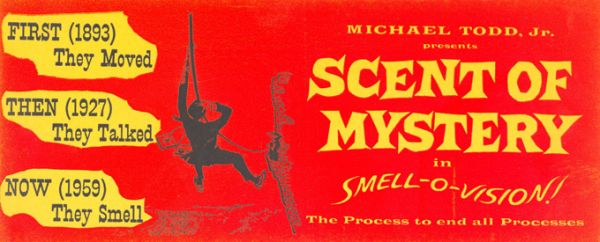
Apparently there was some secret-laboratory-stuff happening at Cinestar Cinema complex in Mainz, Germany between December 1st, 2013 and January 14th, 2014.
At the behest of some movie-mad researchers (Jonathan Williams, Christof Stönner, Jörg Wicker, Nicolas Krauter, Bettina Derstroff, Efstratios Bourtsoukidis, Thomas Klüpfel and Stefan Kramer), high tech filters were attached to the auditoriums airducts so that "a study of ambient air and the chemical changes within it" could be made during various movie screenings.
Wait. What?
Some enterprising scientists (with unsettling personality traits and world domination ambitions?) apparently got funding and then convinced a credulous theater owner to allow them to test a (kinda creepy?) research question:
Will chemicals exhaled (and emitted from other parts of the audience's bodies?) change in response to different films - and perhaps even different scenes?
Ewww...
Ok.
What did the scientists find?
"[M]any airborne chemicals in cinema air varied distinctively and reproducibly with time for a particular film, even in different screenings to different audiences."
Fascinating. But ewwww...
And "[a]pplication of scene labels and advanced data mining methods revealed that specific film events, namely “suspense” or “comedy” caused audiences to change their emission of specific chemicals."
Ewww....
Wait. What?

"In order to assess the data for relationships between film scene content and trace gas behavior [over one hundred volatile organic compounds were measured - but isoprene seems like a good candidate for further research] it was necessary to annotate the film scene content at high time resolution, from a set of preselected labels. Although several approaches to film scene annotation have been reported, including scene change frequency and both audio and visual cues as yet no standardized procedure exists. Suitable independently derived time resolved annotations were also not available from film censor boards nor from the subsequently published film DVDs. Instead, ten volunteers individually viewed the films and allocated descriptor annotations as a function of the film duration using a custom made interface. Each film was labelled at least five separate times. Three different types of scene labels were used. The first set was general in nature and described the film genre using terms from the Internet Movie Database (IMDb). These included terms such as “comedy”, “suspense” or “romantic.” The second set was more specific and referred directly to the scene content such as “chase”, “laughter” or “kiss”, “house pet” or “injury”. These terms were kept deliberately objective to minimize potential labelling differences between individuals caused by personal perception."
And apparently isoprene production did vary in ways that coincided with certain onscreen events - especially scenes that the researchers had tagged as "suspense” and “comedy.”
What?
The researchers hypothesize that humans are spraying out chemicals in response to certain emotional experiences in trace amounts that are detectable by other humans, especially scenes that are about imminent mayhem or relief "as an evolutionarily advantageous alert/stand-down signal."
Is it time to start making more thrillers and comedies for theatrical release (into intentionally poorly-ventilated theaters?) - or to invest in making a 21st century mobile device that offers "nose-buds" and a re-imagined smell-o-vision for viewers watching by themselves on the MRT or at home?
If you want to read more go to: Williams, J. et al. Cinema audiences reproducibly vary the chemical composition of air during films, by broadcasting scene specific emissions on breath. Sci. Rep. 6, 25464; doi: 10.1038/srep25464 (2016).
VR From Google and Blockbuster Director Justin Lin
Google's 360-degree monster short "Help" - directed by Justin Lin (born in Taipei, Taiwan and known for reviving Universal's Fast and Furious franchise with The Fast and the Furious: Tokyo Drift, and directing the July 2016 Paramount release, Star Trek Beyond) - was posted to YouTube on April 18, 2016.
In less than a month, the under 5 minute immersive film has received almost 1.5 million views.
To view in 360, use the YouTube App on a compatible Android device (https://goo.gl/7BYwRJ). For iOS, you can download the Google Spotlight Stories app (https://goo.gl/eadPnO).
Product Placement Lawsuit Reveals Just How Craven Hollywood Has Become
Feel like they couldn't have fit one more ad into Transformers: Age of Extinction (aka Transformers 4)?
Well...
Perhaps the producers should have tried...
As Katharine Trendacosta writes for gizmodo: "Wulong Karst Tourism, a state-backed travel company, is arguing that Paramount and the Chinese co-producer of Transformers: Age of Extinction, China Movie Channel, failed to live up the obligations of a deal they had. The tourism company says it paid $750,000 for a logo with the Chinese characters for “China Wulong” to appear in the movie." And Paramount and China Movie Channel failed to deliver.
Now a court in Chongqing city will hear the case.
For those of you who think of movies as works of art where characters experience life's most challenging questions in deeply moving ways... and not as ad-soaked previsualization for theme park attractions (replacing what Meyerhold described as "lofty destiny" with the up-and-down gut-churning logic of roller coasters), Ms. Trendacosta's April 28th, 2016 post to Gizmodo might serve as a memorable signpost, marking just how far movies have plummeted toward a Chinese government-backed abyss.
In other words, if you bought a ticket to Transformers: Age of Extinction, and it felt to you like a race away from meaningful entertainment and into some fresh ad-infused hell... well, you might be more than a little right.
According to Ms. Trendacosta, the failure to stay on Wulong Karst's good side "turns out to be a major screwup since the people who originally paid $750,000 are now suing [the studios] for $27 million."
Is Nielsen Losing to ComScore When It Comes to Counting Online Viewers?

For 66 years, the Nielsen ratings have been the go-to tool for advertisers and television networks.
And, per an Oct. 23rd, 2015 report in The Hollywood Reporter (the source for the illustration above), Neilsen still dwarfs all competitors in revenue and number of employees.
Nielsen is a legacy business. Almost since the birth of network television, Neilsen's "overnights" have been considered the gold standard for how many viewers were actually seeing a TV ad - and therefore how much money would change hands (the ad rates) for airing broadcast TV commercials in particular broadcast timeslots.
According to an April 26th, 2016 report in TheWrap, the era of Nielsen dominance may be ending.
"Last month, comScore (newly powerful, having merged with competitor Rentrak in Sept. of 2015) delivered its first ratings across digital and TV platforms. “We believe that the future belongs to comScore,” comScore President Bill Livek told TheWrap. Unlike Nielsen, which centers its data around age and gender, comScore provides much richer information, Livek maintained. Nielsen extrapolates its ratings from thousands of households that agree to have “people meters” measure their viewing habits. But comScore data comes from 40 million set-top boxes that cable operators include without most customers even knowing they’re there. ComScore combines that household data with demographic details about consumer behavior. And comScore performs better in areas where Nielsen is weak, according to critics, including measurement of local markets, cross-platform viewing, behavioral consumption habits, and lower-rated networks.“The other guys are currency around age and sex, we’re the currency around how people buy products,” [comScore's Bill Livek] said. “You can target [ad buys] a whole lot better and more efficiently.”"
How Neglected Independent Films (Released Under a Broken Theatrical Model) Inspired Beyoncé's 'Lemonade'

Reading the reviews in Indiewire and the New York Times of Beyoncé's 'Lemonade' that premiered on HBO on Saturday April 23rd, 2016, it's possible to overlook the 65 minute film's roots in independent filmmaking.
In an April 26th, 2016 piece for The New Yorker, Richard Brody explores how the American system of publicizing independently-financed films has failed to support distinctive filmmakers - like Julie Dash - whose 1991 film "Daughters of the the Dust" was one of the inspirations for Beyoncé's 'Lemonade', a visual-album that is itself a fascinating piece of filmmaking.
As Richard Brody notes: "Part of the blame lies with critics—predominantly white critics—who paid no attention [to pioneering African-American woman Julie Dash, and indie films about the African-American experience like her Daughters of the Dust]. But part of the blame lies with a system of tacit complicity between critics and the industry that poses obstacles to the recognition of independent films."
Questions of real-life infidelity in Beyoncé's marriage seemed to dominate new reports - rather than the debt owed to indie filmmakers - when the music and the film of 'Lemonade' were released via the online streaming service Tidal (a company owned by Beyoncé's husband, Shawn "Jay Z" Carter) during the HBO premiere.
Initial reports suggested that after the HBO screening the only place to get 'Lemonade' would be on the subscription-based Tidal. But, as of April 25, 'Lemonade's' music and the film were also for sale on iTunes and Amazon. Amazon even has a preorder option available for a CD/DVD set, which will apparently include the "corresponding short film."
The platforms that are offering the film of 'Lemonade' are in themselves a fascinating story for anyone interested in monetization of non-studio content.
As is the enthusiastic response online - with users marketing 'Lemonade' through copious tweets:
Consider how in the past indie films struggled to get a one-week theatrical run in NY or LA - to merit a review in the leading papers and consideration for year-end awards.
To get a sense of how much Beyoncé might owe to prior filmmakers, take a look at the video below - put together by video essayist Nelson Carvajal - with excerpts from 'Lemonade' on the left set against excerpts from David Lynch's Mulholland Drive and Twin Peaks,Terence Malick's The Tree of Life, Pipilotti Rist's video installation Ever Is Over All, Cameron Jamie's dance short Massage The History, Jonas Mekas' found footage and Terence Nance's An Oversimplification Of Her Beauty.
Currently, there is still no way to stream the film of 'Lemonade' online without a Tidal subscription. And there have been no plans announced for a theatrical release...
UPDATE May 1, 2016: The windowed release (exclusive to TIDAL for the first two days starting on April 23rd, then on iTunes and Amazon on April 25th) has apparently encouraged fans to sign up for TIDAL. (TIDAL may have also been the beneficiary this week of Prince's untimely death, as TIDAL is the only legal service offering access to his library.) After the HBO premiere and the release of Beyoncé's new music and film exclusively on TIDAL, TIDAL which had recently been struggling to attract new users, became the most popular music app on the iOS app store – jumping up 134 places on the chart of the most-downloaded free iOS apps in the US on April 23rd and then another 14 places on April 24th - finishing above both Pandora and Spotify (Apple Music is a native app and therefore isn’t counted). TIDAL is free to download - but there is a US$9.99 per month subscription charge that kicks in after the free trial (US$19.99 for lossless, high-resolution audio). Unlike Spotify, YouTube, and SoundCloud - which have unpaid ad-supported tiers, TIDAL requires a paid subscription. As reported by Tim Ingham in musicbusinessworldwide.com: "As a result of Lemonade, TIDAL has enjoyed many more sign-ups, much higher brand awareness, a sustained run at No.1 on the US app chart and an increasingly solid subscriber income. When TIDAL gets sold – and I for one can’t see Jay Z sticking around too long with what must be a loss-making entity – Beyoncé the shareholder [with a rumored 3% ownership interest in her husband's music streaming service] will collect her winnings."
The Challenges of Selling Hollywood Films Overseas

The Chinese poster for Star Wars: The Force Awakens downplayed the importance of the black lead, John Boyega, in the film.
Why?
"Distributing and marketing American films to other countries is a game of deciphering aesthetics and culture. What appeals to one nation may turn off another. Europe prefers sex to shootouts, while Asia and the Middle East are rapt by action and violence. Italians recoil at science fiction, Argentines drift toward the intellectual, Russians adore "Minions" but are cool to interracial love stories..."
...and apparently someone (in Hollywood?) thinks Chinese movie-goers might prefer to see space fantasies where black characters play less prominent roles?
According to an April 15th, 2016 LA Times article by Jeffrey Fleishman, selling Hollywood films outside the US requires a cultural sensitivity that "you can't learn in Hollywood."
Hmmm...
How a TV Series is Made
An April 14th, 2016 Vox article by Caroline Framke is the best piece I've ever encountered about the writing and making of a US TV series, in this case, the FX TV show The Americans.
How Relativity Media Used Big Data and Screwed Up
In an April 13th, 2016 post to nofilmschool.com, Jack Zhang makes some interesting points about how big data didn't help Relativity Media to beat the Hollywood system - despite some lofty claims by its founder, Ryan Kavanaugh.

I'll reserve comment on Jack Zhang's pitch for his services.

I'll reserve comment on Jack Zhang's pitch for his services.
A Simple Guide to KPIs for Measuring Content Marketing

OK.
But what makes online content marketing special (and different from the interruptive ads that we all knew growing up and watching TV)?
How is content marketing different from Old World marketing?
The central idea behind content marketing?
Content marketing messages will often NOT be about the features of the product being sold.
Instead content marketing is often a funny or awe-inspiring STORY.
For example, a short film that people might share via social media.
Online, people share things, but they don't spread ads - they spread stories.
In successful content marketing, a brand message can ride along as an interesting or useful story spreads online.
In the evolving world of filmmaking, a content marketer is often a motion picture storyteller, working for a brand or product. The thrill and challenge of being a content marketer is making messages that people will actually pay attention to and share in the increasingly crowded media landscape.
And Key Performance Indicators (or KPI) are the methods of performance measurement that really matter to a brand or business.
For example, to measure the success of a content marketing campaign, a business could evaluate many factors. But which factors are really crucial to the success of the organization? And which metrics will accurately reflect the success of this one content marketing campaign (it's possible that certain metrics can tell you how the overall business is doing, but those metrics may be measuring the impact of other factors - and not the success of this one content marketing campaign)?
KPIs will differ for organizations and campaigns.
Some typical business KPIs include an increase (or decrease?) in net revenue over a given time period - or an increase in customer loyalty (as measured by repeat visits or a survey).
But for content marketing, don't businesses want to know how many customers actually acted based on the campaign?
On April 02, 2016 Barry Feldman published "A Simple Guide to KPIs for Measuring Content Marketing" on the Social Media Today website. His insights are invaluable for content marketers.
It's important for filmmakers to understand what KPIs are as we won't get more jobs as online storytellers for brands if our efforts don't have measurable results.
How Much Money Will Disney Make From Star Wars: The Force Awakens?

As of March 20th, 2016, Star Wars: The Force Awakens (released into 4,134 theaters in the US and on movie screens in dozens of other countries one week before Christmas in 2015) has grossed an estimated US $2,057,603,187 worldwide. And that doesn't include home video - the film arrives on digital platforms on April 1, 2016 and Blu-ray and DVD on April 5th, 2016 - or theme parks and merchandise.
So just how much money can Disney expect to make - after expenses - on the latest Star Wars film?
$US 1.3 billion?
That's the estimate made in the March 19th, 2016 NY Times by media analyst Michael Nathanson.
Film Marketing Homework Due April 7th, 2016

To help you with your homework for April. 7th (write a logline, a pitch and an Egri statement for an existing film) please read this post about Lajos Egri's premise tool:
http://www.writerswrite.com/fiction/egri.htm
As we discussed, Egri's "premise" statement is just one of several tools that marketers can employ.
Knowing the "premise" or "big idea" (behind a film you are marketing, or behind a brand or product) can be a source of inspiration when you are writing a marketing message.
Egri's ideas about what makes a great story are still relevant today. Perhaps Egri's ideas are even more relevant than ever in the age of short videos online.
According to Lajos Egri, in a good story, a well-defined character will drive the plot. (And not the other way around.)
Egri’s approach suggests that the conflict in the best dramas comes from a character’s strongest trait (great love, jealousy, ambition, etc.) encountering an obstacle. In Egri’s model - the struggle that ensues when a character’s defining trait encounters opposition will lead to a resolution that reflects the “premise” (i.e., theme, big idea, central organizing principle, moral, etc.) of the drama.
Perhaps you’re familiar with the German philosopher Hegel? Is it possible that Hegel's ideas about progress have influenced Egri’s model? Specifically, that a character starts with a thesis, that encounters an antithesis, and that leads to a resolution or synthesis?
Egri seems to suggest that a protagonist’s defining character trait, organized around a thematic truth, will suggest a conflict that can be organized as a drama with a beginning, middle and end.
For example, a character’s stinginess (thesis), will meet with inevitable opposition (antithesis) and then a resolution (synthesis) – which might be that character’s ruin or a new relationship with stinginess.
As an example of how to write a one sentence statement of "premise," in class we talked about the character of Scrooge in the Charles Dickens classic story A Christmas Carol.
Notice: The "premise" will depend on the message the author hopes to convey.
In A Christmas Carol, all the characters and plot events support a theme that might be expressed as: Generosity leads to happiness.
But another author might think that generosity is a mistake because "extravagance leads to destitution" - and their story would have different plot points and a different outcome.
When thinking about the "premise" of your favorite film, think about the thematic message that the filmmaker has conveyed...
Knowing your film's "premise" might help you to find the best images and text to market that film.
How can you go about discerning a film's premise?
Questions:
Who is your protagonist?
What is your protagonist’s strongest trait (great love, jealousy, ambition, etc.)?
What obstacle(s) are encountered by her or him?
What is the struggle that leads to a resolution for her or him?
What is the resolution?
Is your protagonist's struggle organized as a mounting series of conflicts?
Does a protagonist's defining trait lead to a clear conflict that concludes in a final Act 3 struggle?
Subscribe to:
Posts (Atom)