Showing posts with label Education. Show all posts

Are Media Sites Delivering Their News All Wrong?


In February of 2017, the Director for Ad Engineering for The Washington Post’s Research, Experimentation and Development group, Aram Zucker-Scharff, posted to his personal blog about a better model for delivering the news.

Aram's specific gripe? A lack of evidence to support the design choices news organizations were making online: 

"Few, if any, media companies are backing up their design with user experience science."

Aram argued that not enough attention was being paid to actual user experience. 

By copying what the big guys were doing (e.g., innovating with screens cluttered with ad videos and too many choices), media sites were becoming less, not more, readable.

"The first value every site design should solve for is readability. The people who come to news sites are there to read. Yet bad design patterns that challenge readability don’t just abound, they multiply."

Aram's article struck a chord with me, because I've been urging the educators training tomorrow's filmmakers (and XR experience designers), to instill a deeper understanding of how human anatomy and human perception work.

Here's what Aram wrote about that:

"Understanding how our readers eyeballs work in the general sense means building designs informed not by trends or other news orgs, but by science. Much of that science is publicly available, waiting for us to use."

Finally? 

Aram came out in favor of inviting the users to participate in the design process. Because the tools for delivering connected experiences are increasingly two-way, opening up (in previously unrealistic ways) to user interaction is not only possible, it can actually help to build a sense of community and ownership.

"With better tools and connections into the community we can start driving better choices to impact how we build the news. The news media can start looking at atomic, delayed, or personalized news with the confidence that we can build whole new workflows for reportage that create better engagement with our audience."

Knowing What is Unimportant


知之為知之,不知為不知,是知也。
"What you know, you know, what you don't know, you don't know. This is true wisdom." 
- Confucius or 孔夫子 (551 B.C. – 479 B.C.)
On East 125 St. in Harlem there was a run-down storefront that I never visited. But? Whenever I rode the M-60 bus on my way to LaGuardia Airport, or returning home from a trip, I made sure to look out at the sign over the storefront offering "The Knowledge That You Know, But You Don't Know That You Know".
Logic told me that anyone selling that kind of true wisdom would have a better location. (The same process still has me suspicious of those neon signs offering psychic advice on the seedier sides of town.)
Nevertheless, I remain intrigued by that Harlem "Knowledge" sign. And worried. 
Am I spending too much time pursuing what I don't know (apparently vast)? 
Or? Put another - more foundational - way? Am I focused on the right things? What do I already know that is truly valuable? And what do I need to learn? And how should I learn? Can my personal learning and my teaching of others emphasize more internal and less external?
Why am I writing this today?
A provocative new (Sept. 2018) book by historian Yuval Noah Harari rekindled some of these lingering thoughts. E.g., How do I discern the useless knowledge that I already know from the useful knowledge that I already know? And? Is there knowledge that I might soon know? If only I knew how to access it?
In 21 Lessons for the 21st Century, Hararai writes that today's educators are wasting valuable time: Lecturing about substantive knowledge that is growing out-of-date faster than it can be learned.
One of Harari's key arguments is in favor of reshaping education's current emphasis on quickly outdated substantive knowledge with the ‘four Cs’ - critical thinking, communication, collaboration, and creativity.
OK. This may not be easy. But the sentiment rings true to me.
First, let's consider the downside: Would the world fall apart (or improve?) if teachers shifted their emphasis as Harari suggests to teaching how to "tell the difference between what is important and what is unimportant, and above all, to combine many bits of information into a broad picture of the world.
Second, let's consider the benefit of a radically different approach on the lives of today's teachers. 
One of the paradoxes my fellow educators are dealing with right now? We are paid to transmit knowledge but we know that new technology is making old ideas and old truths irrelevant at an amazing clip. 
Thoughtful teachers realize this. And as the most-dedicated (those who haven't simply given up) struggle to keep up with the tide of new information, I see many good young teachers burning out.
It's understandable. 
The ocean of available information (driven by mobile device connectivity, AI, social media, etc.) is threatening to inundate many old academic disciplines. 
The answer?
Perhaps students need to be exposed to a multidisciplinary approach -  co-taught by teachers from different departments - in modules where critical thinking, collaboration, communication, and creativity are encouraged. And teachers aren't required to share a corpus of facts.
After all, when simply sitting quietly to acquire knowledge yields rapidly diminishing returns, what do teachers and students really need to know? 
Maybe the answer is NOT to teach substantive knowledge at all. But instead? A new approach to learning.
A (close to home) example? Students enrolled in communications and cultural industries programs, if they are lucky enough to have a teacher who understands the current technology and business (rare), will almost certainly find their teacher exhausted. And the "information" the teacher can impart? That's already out-of-date at the end of a student's first year of employment. (Ha. A full year of employment? Straight out of college or grad school? In a cultural industry job? As the "gig" economy changes old ideas about work and compensation at an astounding rate?)
Another (final, I promise) example? It isn't just global warming that's causing the oceans to rise. The tides of new tech and data are washing away entire professions. I know. As someone who holds a law degree, I suspect there will still be people calling themselves a lawyer in 2030. But will many (most?) of them still be doing what a 2018 lawyer does? I doubt it.
Perhaps, I'm wrong. And the Old School teachers will ultimately prevail. As William Blake (1757-1827) wrote in The Marriage of Heaven and Hell (1793):
“If the fool would persist in his folly he would become wise.”
But me? I think educators at the very least need to have a vigorous dialogue about this. After all, William Blake also wrote:
"Without Contraries is no progression. Attraction and Repulsion, Reason and Energy, Love and Hate are necessary to Human existence."

Film Education: Bridging the Gap

The most important part of motion picture making is rarely addressed in film schools. 
That may be because it is constantly changing - and arguably doesn’t even exist. 
In my experience, the most critical part of motion picture making is the gap - the distance between the filmmaker’s work and how the user receives the film.
Is there a film school spending sufficient (any?) time on bridging that gap between the film and the viewer. 
I’m not talking about marketing. 
Although marketing is a part of it. 
I’m talking about the gap that every motion picture must bridge in the endlessly repeating process of touching each unique viewer.
Using language from other disciplines, the gap I am describing might also be called an interface. 
[In computer programming, there are human interfaces, where the software interacts with humans, and there are APIs (Application Program Interfaces), where software interacts with other pieces of software.]
How much thought is given to the gaps where films interact with the audience?
In film schools, directors, cinematographers and editors hear lectures on film grammar - which touch on how humans in general seem to have reacted to certain conventions that were established 100 years ago. And producers take classes on film marketing, where students learn about the platforms and messaging that have historically been used by film studios to get customers to buy a product.
But, as the technology changes and films are created, discovered, circulated and experienced on new devices in new ways, shouldn’t all film students be spending more time thinking about how to bridge the gap between their work and the user?
Especially now that the old super highways for making and delivering motion pictures are collapsing and new roads - including millions of winding social media pathways - are appearing?
Yes. Most of today’s paths to viewers are difficult and dangerous. 
Relying on old conventions and the routes of the last century is easier. And relying on (now incorrect) legacy ideas is all many film teachers know. So much (most?) of the University teaching about motion pictures consists of talking about the old ways - as if the still had a chance of bridging the gap - with a few teachers stitching in info about the few commercially-viable remaining pieces. 
It’s expedient for the teachers. But is that approach optimal for the students?
The wrong tools beckon because they are easier. And traditional.
But should decisions about what to teach and how to teach be based on what worked for the last century?
I am not suggesting that we break all the toys. But conservatism that ignores how motion pictures have changed - and will continue to change - seems destined to fail the students. 
And don’t Universities have a duty to advance the practice of the art?
I’ll readily admit there is no one true method. No silver bullet. 
But simply teaching the old tools and techniques - without addressing the changing context - is folly.
As user experience pioneer Alan Cooper has observed: "The assumption that the merits of a given method are its merits at all times, in all places, and for all practitioners, is simply not true."

In my view, motion-picture-making education would benefit from a refocus on the people and the processes (new models of creative collaboration and interactivity targeted at bridging the gap), rather than a continued focus on Old World tools and techniques. 

And, unfortunately, managers attached to an Old World “command and control” model are the wrong choice to implement the necessary changes.

Filmmaking for the 21st century is not what it was 20 or even 10 years ago.

21st century filmmakers must embrace the challenges of bridging the gap. 

The insights and perspective that will focus on how the users will interact with motion pictures are not part of traditional film education. But, increasingly, they are what really matters.


Marketing a Story about the Silk Road Using New World Tools: A Reporter Goes on an Epic Journey


To build interest in his reporting about Ross Ulbricht - the young man whose mastery of New World tools ended in a May 29th, 2015 life sentence for founding and operating the global online drug market Silk Road - Wired writer (and author of the article that served as the source for the Academy Award winning Argo screenplay) Joshuah Bearman made a noteworthy marketing video - complete with allusions to the reporter's own hero's journey.  

Notable because, in addition to being a teaser for the dramatic story in Wired, the video culminates with an account of the reporter's own voyage of discovery. 

In other words, this marketing video isn't just about the soon-to-be-a-movie story of Ross Ulbricht - the (spreadable?) video starts by suggesting that the real world story fits into the tropes of a movie - and the Wired video then builds to a conclusion that revolves around the obstacles Mr. Bearman - the reporter - had to overcome.

There's little doubt that Joshuah Bearman's account - touching as it does on the sensational story and the difficulty of his process - is a well-thought-through marketing technique. 

I suspect it will work to tout the two-part series in Wired and the inevitable movie.

At what cost? 

Can Wired readers appreciate a heroic Joshuah Bearman as a guide (into an already deeply compelling story) without paying a price in objectivity? 

In the 21st century, will heroic writers discussing their process - accompanied by fanciful erotic and violent animated images - become the acceptable new standard for selling journalism?

Or does this form of marketing unnecessarily blur the ethical lines - implicating one of Old World journalism's basic rules? 

Is it OK for Joshuah Bearman to market the story by comparing the story to fiction and by becoming the center of the marketing story?

This is a tough one.

One thing's for sure, Joshuah Bearman is not your average Old World ink slinger.

3D Augmented Design: Oculus Rift


The Oculus Rift is a virtual-reality headset designed for consumers and developed by Oculus, a company founded by Palmer Luckey. 

In 2011, frustrated with the few prototype virtual reality headsets he was able to try, Palmer Luckey (who earned money fixing and selling discarded mobile phones) created his own device working in his parents’ garage from parts he found on government auction sites and industry equipment liquidation sales. He was 18.

By mid-2012 Palmer Luckey felt ready to launch a Kickstarter campaign. As he explains, he wanted "to get money to buy all of the components required on a slightly larger scale and then send these out to people as kits so they could assemble them themselves using my instructions so they could have the same thing as I had. I figured it would be a really cool thing to have a couple of VR nerds toying around."

His Kickstarter was successful: Raising US$ $2,437,429 (from 10,000 people) or 974% of its original target. 

In 2014, Oculus sold to Facebook for US$ 2 billion.

Here are links to a few scholarly articles about virtual environments and how the ability to create immersive experiences might change learning, business, medicine and design:

http://oro.open.ac.uk/38386/

https://otik.uk.zcu.cz/handle/11025/1662

http://www.columbia.edu/cu/gsapp/BT/RESEARCH/PAPERS/ar-asce.html

http://computingengineering.asmedigitalcollection.asme.org/article.aspx?articleid=1399995


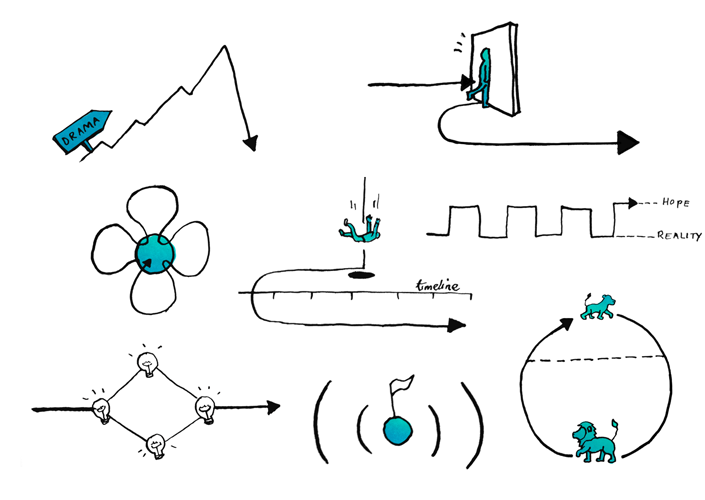
8 Classic Storytelling Templates


Don't let the deceptively simple diagrams or the context (an article about making better presentations) throw you off.

There is much that an aspiring screenwriter or film marketer can learn from great oratory.

As it turns out, listening to a master storyteller - while looking at a clear diagram of their story's structure - is actually a great way to absorb essential information about how great stories can be organized.


The three act Hero's Journey template - that most film schools teach - is just one of the variations.


To consider some of the other storytelling structures that many aspiring screenwriters will want to examine, take a look at Ffion Lindsay's November 14th, 2014 incredibly helpful summary of templates for storytelling.

Elsewhere on this blog, I have bashed the outright ignorance and (boring?) old world certainties offered by some famous "screenwriting experts." But I also understand that structure and craft can be (must be!) studied. So I'm deeply grateful for the work Ffion Lindsay has done in compiling these examples of great storytellers working within different structural paradigms.

The ABBA Videos of Lasse Hallström: Video Essay Written and Narrated by Jed Mayer and Edited by Nelson Carvajal


'Before MTV, music videos were a novelty. Elvis’ fifties musicals and Richard Lester’s films for the Beatles in the 1960s established many of the conventions of the genre. Swoony close ups, rhythmic jump cuts, and intimate, casual footage of the band goofing off captured the experience of listening to the music, and indulged the audience’s fantasy of hanging out with the group. Singers like Nancy Sinatra and Lee Hazlewood filmed television specials that ran like mini-movies, juxtaposing performance with narrative film-making, setting the singers against exotic landscapes, creating fantasy visions of the songs’ lyrics. Then along came [Lasse Hallström, a young Swedish director who would go on to make eccentric and touching comedies like My Life as a Dog, What’s Eating Gilbert Grape, and Chocolat and lighthearted 70s pop group] ABBA.'

Teaching at the Beijing Film Academy - Oct. 27th-31st, 2014

Awards Ceremony May 16th, 2014 Beijing Film Academy: R-L, Prof. Randy Finch, Prof. Chan Chang, Prof. Daw Ming Lee, President of the Beijing Film Academy Zhang Huijun

If you will be in Beijing from October 27 - October 31st,  I will be speaking at the Beijing Film Academy about legal issues and the changing film business.  

I am honored to have been invited to return to the Beijing Film Academy  - this time to lecture about copyright/IP, labor unions and deal-making in the 21st century motion picture business. 

As many of you know, I am fascinated by the changing paradigms for motion picture creation and circulation.

I will be talking in Beijing about those revolutionary changes - drawing on my experiences as a film producer and lawyer and as an educator with growing experience in S. E. Asia.

At the Beijing Film Academy I will be talking about the Hollywood and the American indie film models, but I'll also explore how the internet is challenging old ideas about copyright and Hollywood film production - and how a new paradigm for motion picture production and revenue (increasingly driven by China's rise as a major film power) might unfold.

I will post more details about the times and locations of next week's lectures and seminars as that information becomes available.

How Camera Movement Affects a Scene: The Career of Paul Thomas Anderson in Five Shots


Thanks to Kevin B. Lee, film critic and producer of over 100 video essays, who put together this short film examining some of P. T. Anderson's best steadicam shots.

Why Educators Who Don't Understand The New Tools, Including Coding for Interactivity and Social Media (e.g., Online Data Collection and How Content Spreads on the Internet), Shouldn't Be Teaching Tomorrow's Filmmakers


As Sun Tzu wrote in The Art of War: "If you know neither the enemy nor yourself, you will succumb in every battle.” 

The interactive installation by video artists Taiyun Kim and Ji Hyun Yoon (promo video above) is a great example of how a technical understanding of the new tools allows artists to comment on 21st century culture. 

I don't want to become tiresome, but so many academics - as well as many leading critics of 21st century culture - are incapable of seeing the New World. 

If all you care to know is your own outmoded (and often profoundly mistaken) conception of how the new things work, how can you write about contemporary motion pictures or teach the artists of the 21st century?

Festivals, Schools and Non Profits: A July 2014 Discussion Between Leaders of the Support Structures for Indie Filmmakers Organized by Ted Hope's Reinventors Network

Will MOOCs Work in Refugee Camps or Is "Democratizing Education" Just Marketing Hype?


In February of 2014, Reda Sadki, Senior Learning Systems Officer in the Learning and Research Department of the International Federation of Red Cross and Red Crescent Societies, uploaded this video of his interview with Barbara Moser-Mercer - the "lady who did a MOOC in a refugee camp."


Although the case study that Prof. Moser-Mercer describes only involved two learners in Dadaab, Kenya - I think it deserves to be part of the larger ongoing conversation about MOOCs.


In this video, Prof. Moser-Mercer speaks eloquently and convincingly about the potential of online learning in places -  in this case Dadaab, the world's largest refugee camp - where traditional higher education is not available.


It's difficult to imagine a more challenging environment for learning than an insecure and arid refugee camp with 500,000 residents on the border of war-torn Somalia.  But that is where Prof. Moser-Mercer, a cognitive psychologist from the University of Geneva, has chosen to do her heroic work. 


The refugees that Prof. Moser-Mercer worked with come from cultures that support sharing and communal activity (eye-opening for me, because I'm only familiar with the competitive approach to education that my students have pursued to gain entry to exclusive higher education in China and the West ).  

And in Dadaab (as in other places outside Western capitals) a certificate verifying a marketable skill can be a life-changing goal. 


In other words, a higher education at a premiere university isn't the only or optimal goal... and a MOOC can offer education for an entire community that co-learns with the student who is actually pursuing a certificate.


I'm ashamed to admit it, but this short video has forced me to reconsider (mitigated) my skepticism about MOOCs.

If you're an educator - or concerned about how the web can democratize educational opportunities - maybe it will have a similar effect on you.


Are You Ready for Augmented Reality? Tunnel Vision NYC


Want to know when the next train is coming?

Or how many people are crossing through the subway turnstiles in Times Square?

What about rent and income data for various neighborhoods in NYC?

Thanks to creative coder William Lindmeier there's Tunnel Vision - "an augmented reality app that uses the subway map as a canvas for displaying public data about the city's residents."

Tunnel Vision was developed as Bill Lindmeier's thesis at ITP - "a two-year graduate program located in [NYU's] Tisch School of the Arts whose mission is to explore the imaginative use of communications technologies — how they might augment, improve, and bring delight and art into people's lives."

As described in a May 21st, 2014 post to Mashable, "Once you download the app (iPhone only) you just open it up and point your phone's camera at any subway map. It doesn't matter if it's a full-sized map in a station or a PDF on your computer screen, the app will recognize it and automatically display a stunning array of visualizations based on MTA and Census data and pegged to the various subway stops. From turnstile activity to rent prices to the real-time positions of trains, you're able to explore the city through the subway."

Filmmakers may want to consider the storytelling possibilities of interactive maps.

Would a similar map (maybe including elements from a fictional world?) work in another city - say Beijing - allowing users to get useful information about the real life of the city but also perhaps tracking fictional characters (e.g., what neighborhoods are currently under attack?)?

Selections from Bill Lindmeier's Portfolio: wdlindmeier.com 
Email: bill@wdlindmeier.com 
Twitter: @wdlindmeier

Randy Finch's Film Blog:

Thoughts from a film producer about making and distributing films.